The best camera for night IRL streaming
By Elan Harpaz · Published 2026-10-24
Most IRL streaming happens after dark, which is exactly when small sensors fall apart. The cameras that hold up, and the settings that matter.
Your encoder tops out at 1080p60. A higher-end encoder would go further.
Buy links are affiliate links: we earn a commission at no extra cost to you. Prices are tracked estimates, not live prices. Full disclosure
| Component | Pick | Price | |
|---|---|---|---|
| Camera | DJI Osmo Pocket 3 Gimbal cam with great low light, USB webcam mode, and DJI mic pairing. The IRL favorite. Buy on Amazon | $495 | Buy on Amazon |
| Encoder | Orange Pi 5 + belaBOX Dedicated HDMI-in encoder running the free, open-source belaBOX firmware with SRTLA bonding. The DIY backpack heart. Buy on Amazon | $150 | Buy on Amazon |
| Connection | Netgear Nighthawk M6 5G mobile router with an ethernet port, so you wire it straight to the encoder. Buy on Amazon | $447.22 | Buy on Amazon |
| Data Plan | Visible Unlimited Truly unlimited data on the Verizon network. The IRL favorite for a cheap single line. Learn more | ~$25/mo | Learn more |
| Bonding | belaBOX SRTLA Bonds several connections to your relay, built into the belaBOX encoder. Free. Learn more | Free (with belaBOX) | Learn more |
| Relay / VPS | belaBOX Cloud Managed SRT relay plus phone control to start/stop the encoder. The cheap, popular choice. Learn more | ~$10/mo | Learn more |
| Power Bank / Portable Battery | SHARGEEK 140 (20K, 140W) High-capacity, high-wattage bank that runs a power-hungry encoder all day. Buy on Amazon | $79.89 | Buy on Amazon |
| Audio | DJI Mic Mini Tiny wireless lav that pairs straight to the Osmo Pocket 3, keeping audio in sync. Buy on Amazon | $79 | Buy on Amazon |
| Mount / Stabilizer | DJI Osmo Mobile 6 Proven phone gimbal for smooth handheld footage with a built-in extension rod. Buy on Amazon | $99.99 | Buy on Amazon |
Daylight flatters every camera. The honest test for an IRL camera is a city street at night, where sensor size and lens aperture decide whether your face is visible or a smear of noise. It is also the hardest case for your bitrate, because noise is motion as far as an encoder is concerned, and noise eats bitrate that should be going to detail.
Why low light costs you twice
A noisy image is expensive to encode. Grain changes every pixel every frame, so the encoder spends its budget describing noise instead of your face. A cleaner sensor at the same bitrate looks dramatically better, which means the camera choice and the bitrate choice are the same decision.
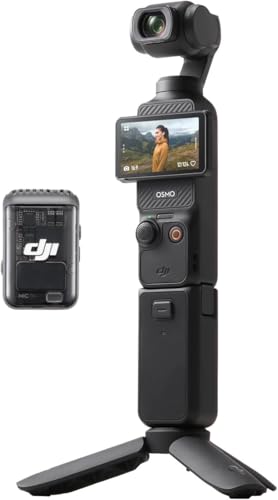
The larger sensor and built-in gimbal make it the default night pick. Clean at ISO levels where action cameras fall apart, and smooth while you walk.

The rugged choice with respectable low light. Take it when weather or impact is likelier than perfect image quality.

The most stabilised and the widest, though the small sensor shows its limits after dark. Confirm it charges while outputting video.
Settings that matter more than the model
- Cap the shutter around double your frame rate. Slower looks brighter but smears every time you turn.
- Lock white balance. Auto white balance hunts under street lighting and the colour shifts mid-sentence.
- Cap the ISO. Left alone, most cameras will push ISO until the image is unusable rather than let it look dark.
Frequently asked
Does a bigger sensor matter more than resolution at night?
Yes. A larger sensor gathers more light per pixel, so it stays cleaner as light falls. A 4K image from a tiny sensor at night carries more noise than a clean 1080p image from a larger one, and the noise costs you bitrate as well.
Should I lower my bitrate at night?
The opposite problem applies: night footage needs more bitrate because noise is expensive to encode. If you cannot raise it, reduce noise at the source with a light and an ISO cap.
About this guide. Written by Elan Harpaz. We do not lab-test hardware. Every quality verdict on this page is a planning budget computed from a published model, and every price is a tracked estimate rather than a live one. How the numbers are derived: methodology. How picks are chosen: editorial policy.
Build on this in the configurator